Beyond the Breach
Deterrence, Resilience, and AI Warfare
How can a state or institution remain secure when breaches cannot be ruled out and machines accelerate action while responsibility remains human?
A shift from perfect prevention to knowing what happened, deciding legitimately, containing harm, and restoring critical functions and trust.
An invitation to readAn invitation to read
The trilogy’s final volume begins with a question that precedes deterrence: how do we know what happened? An operation can pass through intermediaries, use widely available tools, and leave imitable signs. The book therefore separates trace, campaign, operator, and commanding authority, as well as what a security firm can observe, intelligence can know, government can publish, and a court can test.
From that gap it moves to legitimacy. Offensive capability may need secrecy to retain value, a response may sit below the threshold of armed conflict, and an agency retaining a vulnerability may conflict with a defender of public systems. The analysis avoids a simple moral binary, while insisting that secrecy does not remove the need for constraints, oversight, and boundaries on surveillance and delegation.
At the book’s engineering core, resilience becomes design: identify critical functions, separate failure domains, maintain usable alternatives, and restore data, identity, and trust. AI then accelerates reconnaissance, execution, and influence while creating new targets. The journey ends with an Arab doctrinal question: how can command, coordination, and sound judgment persist when communications degrade and human and machine assessments diverge?
A thought you can test
Illustrative model · invented inputs, not evidence or a prediction.
What exactly has recovered?
All four dimensions are represented here, but even checking all four is not a real recovery certification.
- Service — A service responds.
- Data integrity — Records are checked against trusted evidence.
- Identity — The system can distinguish authorized actors.
- Public trust — People have reasons to rely on the institution again.
Concept laboratory
The attribution ladder
A trace is not a campaign; a campaign does not establish an operator; an operator does not by itself prove command or intent.
Trust as infrastructure
Trust rests on verification, correction, challenge, and accountability—not a promise that failure will never occur.
The resilience loop
Illustrative cycle: honest detection, proportionate containment, alternate operation, trustworthy recovery, and learning that changes design.
Illustrative model · invented inputs, not evidence or a prediction.Responsibility does not transfer to the model
Greater machine capacity for analysis or action does not remove the human duty to set permissions and own decisions.
Anatomy of the argument
An analytical reading of the supplied brief. These stages are not manuscript chapter titles.
- 01
From trace to attribution
Calibrate what technical, intelligence, and legal evidence supports without leaping from a tool to the authority that ordered its use.
- 02
Deterrence and legitimacy
Test deterrence in the gray zone and balance secrecy, oversight, and rights within a cyber-capable state.
- 03
Designing resilience
Move from protecting everything to preserving critical functions, containing failure, and recovering operation, knowledge, and trust.
- 04
Agents and accelerated influence
Separate observed capability from projected scenarios, and examine delegated authority and attacks on models, tools, and supply chains.
- 05
Toward an Arab doctrine
Connect Gulf dependencies to delegation limits, command continuity, and civil-military decision integrity under uncertainty.
Visual library
Original conceptual studies. Covers are proposals; captions are editorial writing, not manuscript quotations.
Beyond the Breach
How can a state or institution remain secure when breaches cannot be ruled out and machines accelerate action while responsibility remains human?
Download SVG study ↓
A shift from perfect prevention to knowing what happened, deciding legitimately, containing harm, and restoring critical functions and trust.
Download SVG study · 2:1 ↓

Service return does not contain all recovery
A responding system is an important condition, but it does not by itself establish sound data, identity, or trust. The study isolates operation as one dimension without letting it absorb the others.
Download SVG study ↓
Data integrity after interruption
Records must be more than available: their correctness, consistency, and inspectability still matter. This dimension separates restored access from a restored basis for dependable work.
Download SVG study ↓
Continuity of identity and permission
Recovery requires the system to distinguish authorized parties and connect actions to accountable actors. Restoring service without that capacity leaves a central question unanswered.
Download SVG study ↓
Trust is rebuilt after repair
Technology may operate before people and institutions have adequate reasons to rely on it again. Rebuilding trust is an institutional and interpretive process, not a green light issued by a machine.
Download SVG study ↓
The seams between recovery dimensions
Operation, data, identity, and trust meet, yet each can still fail independently. Keeping the seams visible prevents a partial repair from being declared a complete recovery.
Download SVG study ↓
An independent readiness check
Each condition needs evidence suited to it before the results are combined into one judgment. This check organizes questions; it does not certify that a real system is secure.
Download SVG study ↓Six small arguments
Showing deterrence can spend its secret
A state may need to signal capability, yet disclosure can burn the sources or tools that make it valuable.
Download SVG study ↓

What must recovery restore?
Is restarting a machine enough, or must the institution also restore data integrity, identity, and public trust?
Download SVG study ↓

Confidence and inspectability
An internal judgment may be strong because of secret sources while remaining different from evidence the public can test.
Download SVG study ↓


NotPetya as an attribution problem
The interval between spread and official accusation reveals how evidence moves across research, intelligence, and policy.
Download SVG study ↓
Security after breach
An illustrative measure of knowledge, legitimacy, containment, recovery, and learning—not blocked attacks alone.
Download SVG study ↓

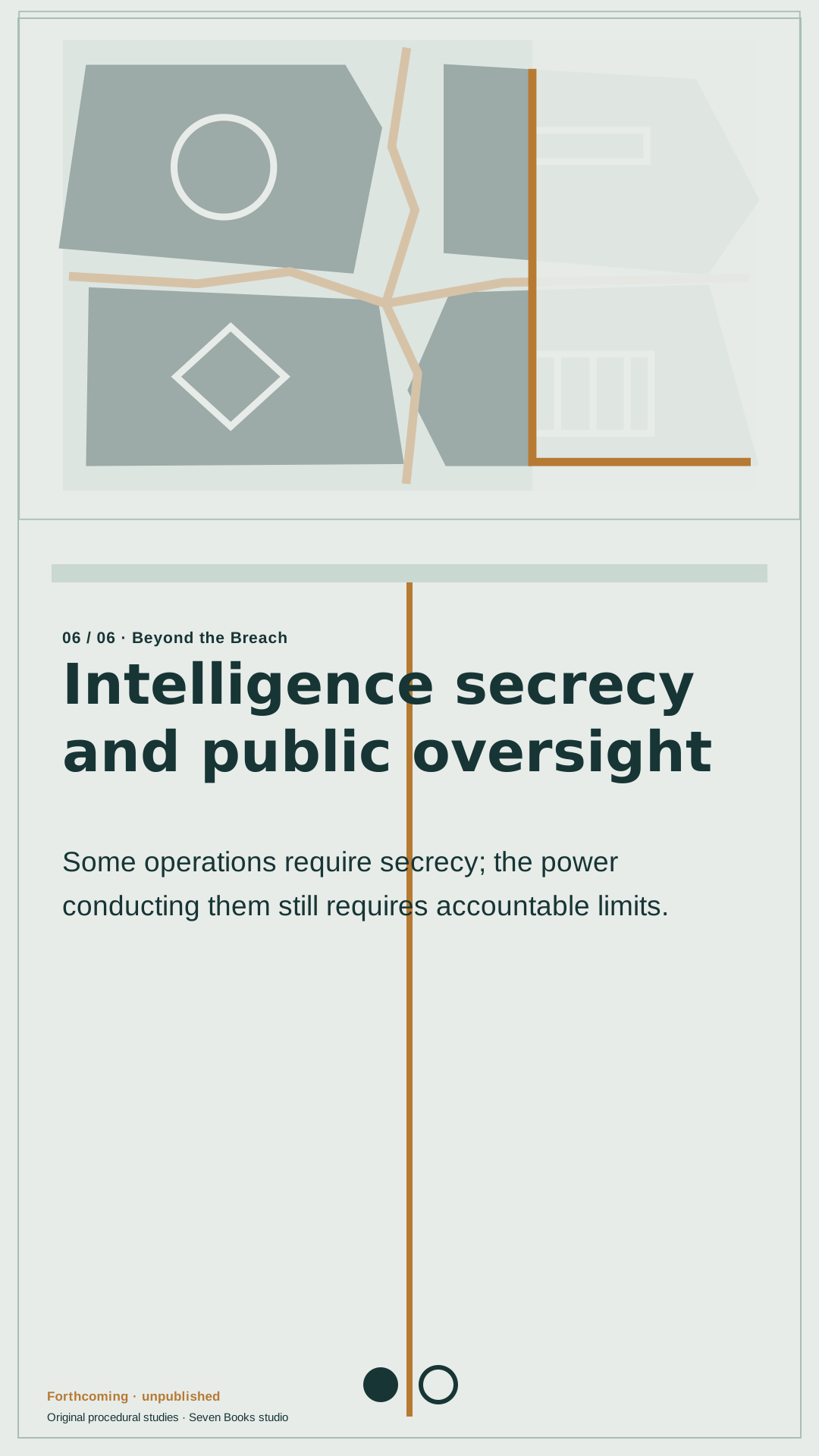
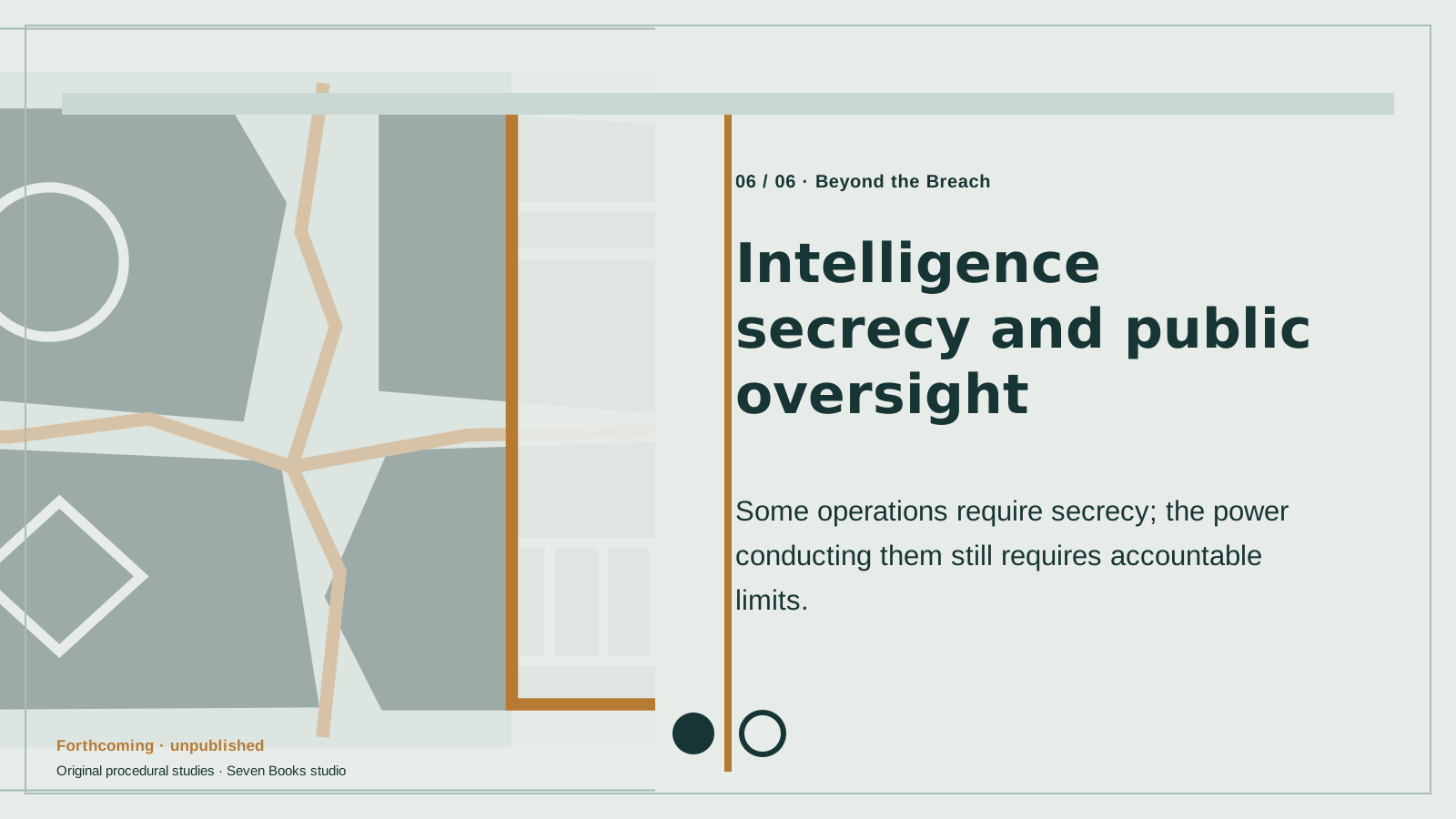
Intelligence secrecy and public oversight
Some operations require secrecy; the power conducting them still requires accountable limits.
Download SVG study ↓
Original procedural studies · Seven Books studio · Project-original procedural geometry
Continue the question
The Birth of Hidden Power
How did computer networking move from an engineering benefit to a domain of political, intelligence, and market power?
02The Age of Blowback
What happens when cyber capability enters a world where an operation’s effects do not stop at its intended target?
04Beyond Digital Transformation
How does an institution change when producing knowledge becomes cheaper while verification costs and decision responsibility remain?
05Hinges of Power
Does power lie in owning a resource, or in moving, stopping, and restoring it while a decision still matters?
JournalSecurity Is a Design Decision
Security becomes credible when access, friction, recovery, and accountability are designed around the harm at stake.
When the work becomes available
Choose the books you want to hear about. A confirmation email verifies your address before any release notice is sent.
Publication notifications are not open yet. No address is collected here.
Privacy and consent ↗