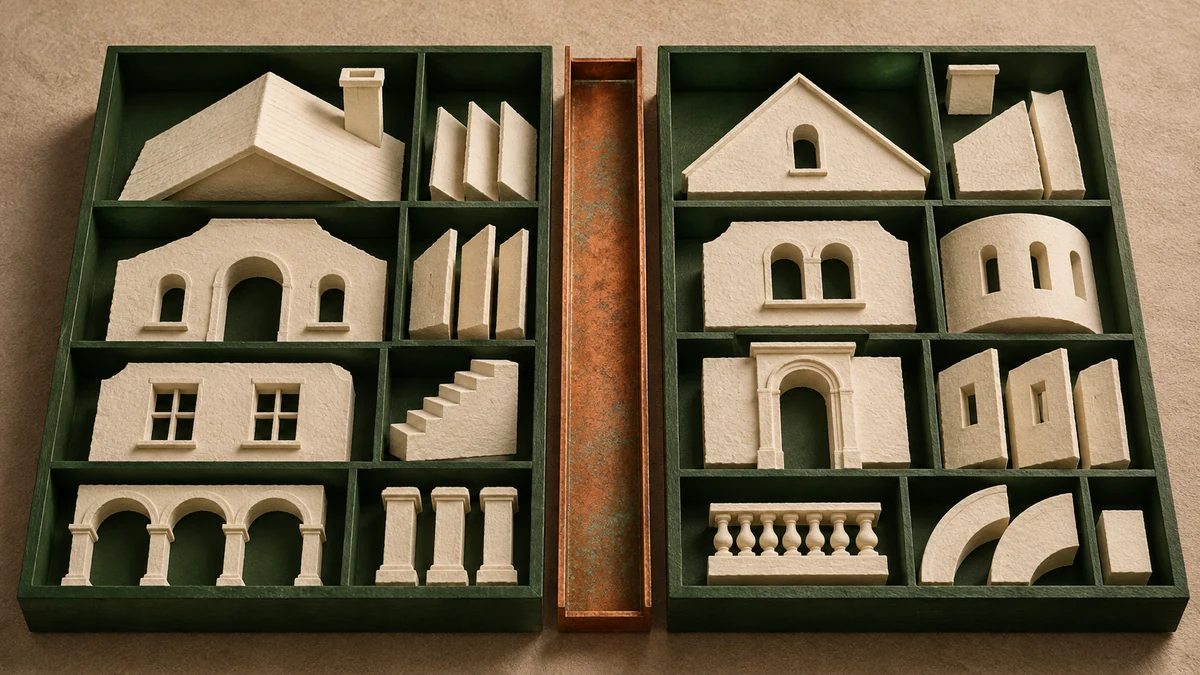
Dividing a building into transferable shares can widen access, but only rights, buyers, market depth, and accountable institutions can turn those shares back into usable cash.
Keywords real estate tokenization · fractional ownership · secondary markets · market liquidity · market depth · property rights · Dubai property · Detroit housing · adverse selection · digital assets
In this article
- 1
A documented and enforceable property right
- 2
A live buyer for the desired quantity
- 3
An executed price after entry and exit costs
- 4
Reliable settlement, governance, and building responsibility
A transferable record is only the first link; practical liquidity requires buyers, depth, rights, and institutions capable of carrying responsibility through stress.
Detroit, When the Last Buyer Disappeared
On July 22, 2025, a judge in Wayne County Circuit Court in Detroit signed a temporary order barring companies associated with a tokenized-real-estate project from collecting rent on properties that lacked the required certificates of compliance. The order addressed conditions in certain dangerous buildings, required rent to be deposited in escrow accounts, and prohibited the eviction of tenants from noncompliant properties. On the court's papers, the issue was not innovation in digital ownership. It was homes occupied by people, safety conditions an owner had to meet, and money that could no longer be collected as before until those conditions were satisfied.1
Those properties belonged to a world in which an investor can buy a small share of a building never visited and receive a portion of its return without holding its keys. But the financial effect of the court order extended beyond rent. According to an economic study published by the Bank for International Settlements, the platform stopped repurchasing tokens tied to properties covered by the order. Comparing trading in those assets with trading in other tokenized assets outside the decision, the researcher found a statistically significant fall in transaction activity after the repurchase window closed. The digital ledger remained technically capable of calculating each owner's share, but the institution accustomed to standing on the other side of the trade was gone.2
The court did not rule that day that every tokenized property was a corrupt investment, nor did the study say that every token holder lost money. A temporary order in a compliance dispute must be distinguished from a final judgment, just as lower trading activity must be distinguished from a falling price or a realized personal loss. The episode nevertheless tests a large economic claim: when a home is divided into thousands of transferable rights, what makes those rights saleable for cash, at the needed time, and at a price that does not punish the owner for needing money? The question on the screen concerned a token. Its answer came from a housing authority, a court, a tenant, a bank account, and a platform's balance sheet.12
Real-estate tokenization is alluringly simple in its first presentation. A building is worth two million. An employee cannot save two million to own it. A platform divides its value into a million digital shares; each person buys what they can and becomes entitled to a portion of the rent or sale proceeds under the governing documents. People whose savings could not open the old market gain entry. That is a real benefit, and accepting it requires no intellectual concession. The question begins after the offering: more people can now buy for the first time, but has the number prepared to buy from a seller under pressure increased by the same degree?
This is where the word “liquidity” multiplies in promotional material until it loses part of its meaning. Being able to register a share in an app around the clock is different from placing a sell order around the clock; finding a matching buy order; having the trading system accept it; completing the transfer of the right; and receiving net proceeds that can actually be used. The first of these events is a software feature. The last is an economic and legal result. An entire market lies between them. Put plainly, opening an electronic door does not create the person who will walk through it.
Dubai Connects the Token to the Property Register
In March 2025, the Dubai Land Department launched a pilot to tokenize property title deeds with regulatory and technical partners. On February 9, 2026, it announced that phase two would activate resale from February 20, within a pilot scope allowing about 7.8 million property tokens to be retraded. The stated purpose was to test market efficiency, operational readiness, and the protection of rights—not to declare those tests complete in advance.34 Technical partner Ctrl Alt said at the start of phase two that the first phase had covered ten properties worth more than AED 18.5 million, and that every transfer within the permissioned model was connected to official land records.5
That progress deserves to be taken seriously because it addresses a basic defect in many asset-tokenization promises: the gap between a screen displaying a digital token and an official register determining who holds the property right. A token without a reliable legal link can become an encrypted souvenir of something its holder cannot claim. In the Dubai model, the platform describes the investor's right as a registered property share, using two connected representations—one for the title deed and another for share allocation—with investor data appearing in the relevant registration system.6 This legal form is not the only possible one in the world, and its results cannot be copied into another jurisdiction merely by copying its code.
In October 2026, PRYPCO Mint published a presentation of research on tokenized-property liquidity. It reported AED 18.65 million invested across ten properties, participation by more than 2,600 investors of over fifty nationalities, and said about 70% were entering Dubai property ownership for the first time. The presentation accompanying the operator's report says all ten properties saw resale activity in the secondary market.7 These are signs of wider access and real trading. By themselves, however, they do not disclose how many sell orders found no buyer, median execution time by order-size category, the actual gap between asking and executed prices, or the liquidity available if twenty holders try to exit on the same day. The number who entered the market is not a measure of who can leave it.
A Possible Sale Is Not a Guaranteed Sale
The most revealing text here is not the announcement of an achievement but the FAQ an investor reads after pressing “sell.” Three months after the property's original funding date, an eligible holder can list tokens worth at least AED 1,000. The asking price must be within 15% above or below the reference valuation, in increments of five percentage points. Then comes the sentence that should head every advertisement for “instant liquidity”: listing tokens does not guarantee their sale; execution depends on buyer demand.8
Even if the ownership register moves within five to ten minutes after a match, as the platform describes its process, that interval begins after the trade has been found. It does not measure how long the seller waited in the first place. A share might spend two weeks without a buyer and then transfer in five minutes. It is fair to say that the transfer of ownership is faster. It is not fair to infer that the sale of ownership itself took five minutes. There are two clocks: the wait for a matching price, and the settlement of the right after the parties agree. Much confusion in comparisons between traditional and tokenized property hides between them.
Put the numbers at the scale of an ordinary saver. PRYPCO Mint publishes an entry fee of 2% for the platform, 2% for the Dubai Land Department, 0.1% for tokenization subject to a stated cap, and a 1% exit fee when a sale is completed; ongoing management costs are also included in the displayed rental-yield estimates.9 If someone buys shares with a net investment value of AED 10,000, the platform's published example gives an initial cost of AED 10,410. If the shares are later sold at the same reference value, once eligible and with no price change, the holder receives AED 9,900 after the exit fee. The AED 510 difference is a trading and establishment loss of about 4.9% of the cash paid, before rent received or any other fees and effects. This is a conditional illustration, not the historical return of a particular investor. At a 10% discount to reference value, proceeds after the exit fee become AED 8,910; the shortfall from the cash originally paid is then AED 1,500 before rental income. Dividing a property unit into small parts did not divide transfer fees into nothing.
Nor does an allowed price range create fair value merely because it is aligned with an official valuation. An appraisal is a professional effort to estimate an asset's value on a particular date from assumptions, comparables, and cash flows. An executed market price answers a different question: what did a specific buyer pay for a specific share at a specific time? The market may reveal a discount reflecting uncertainty, need, or weak trading; it may also impose a discount not justified by the property's condition. Strict pricing limits can hide a trade the parties would have accepted outside them, producing an absence of trading rather than an observed price. Appraised value, asking price, executed price, and net cash in the seller's hands must therefore remain separate, even when their dashboard numbers look alike.
Market Depth Lies Beyond the Listing Button
Consider an order book. Suppose—strictly as a teaching example, not a description of an actual platform—that a holder wants to sell shares with a reference value of AED 10,000 within two days. Existing buyers offer to take AED 1,000 at a 5% discount and AED 2,000 at a 10% discount, with no firm orders for the rest. The owner sees prices on the screen and perhaps continuing activity in some tokens, but cannot obtain the needed liquidity on time. Selling the available portion may leave the remainder harder to dispose of as the need for cash grows. This is market depth: the amount of money capable of absorbing a new order at different price levels. The existence of a platform is not a measure of that depth.
The test becomes more exact when an indicative price is distinguished from a party bound to buy. Bid–ask spreads narrow in many markets through market makers, competition, and information. Yet an order book can contain many small orders easily withdrawn at the first shock. In financial literature, Albert Kyle studied the price impact of orders as a measure of depth, while Yakov Amihud examined the relationship between price movements and trading volume as a proxy for illiquidity.1011 Those measures should not be transferred mechanically to tokenized property. When transactions are rare and valuations change only periodically, price volatility may look low not because the market is deep but because it has not traded enough to reveal a price. Silence is not statistical stability.
Another limit cannot be cured by adding decimal places. Tokens backed by one apartment building in one neighborhood are not necessarily interchangeable with tokens backed by another, even if their nominal prices match. Each building has its own age, vacancies, tenants, deferred maintenance, obligations, voting rules, property manager, and perhaps disputes. A ten-property project can therefore become ten small markets rather than one deep one. Fractionalization succeeds when many shares can be issued; trading succeeds only when enough economic and legal similarity lets demand gather around the same asset. Token transferability does not erase differences between buildings.
Suppose one shareholder sells after moving for work and needing a down payment on a new home, while another sells after learning from a technical report that the building's lift will require costly replacement. A buyer sees both orders but cannot always know the true motive behind either. This is adverse selection, familiar since George Akerlof's study of markets in which the seller knows more about quality than the buyer.12 In a small market where sellers disproportionately carry bad news, buyers may discount every asset, leading owners of better properties to withdraw rather than accept the reduction. This is not inevitable for every property token. It is a mechanism that property disclosure, independent valuation, expense auditing, and accessible histories of occupancy, maintenance, and disputes must counter.
Fractional Ownership, Whole Responsibility
A deeper matter follows. Economic fractionalization does not entail operational fractionalization. The value of a flat can be divided among a hundred investors, but one cannot replace 1% of its drainage, repair 0.5% of its roof, or make a tenant endure a fractional alarm failure. A building is an operational unit requiring whole decisions. Who chooses the management company? Who approves the maintenance reserve? Is all rent distributed before emergency contributions are requested, or are reserves withheld first? What if one-third of the owners want to sell the property and the rest prefer to rent it for ten years? Clear governance can resolve or reduce these tensions, but a voting system does not perform maintenance in place of a technician or pay a tenant what is due automatically. A share becomes more valuable when its owner's right is enforceable, not when an app offers more voting buttons.
Detroit now returns from a side the promotional promise seldom pauses to consider. A tenant is not a “reference asset” producing cash flows on an elegant chart. The tenant lives with the effects of the financial decision every morning. If a housing unit deteriorates, the first question is not how far the token's yield fell, but who will make the place habitable, who has authority to spend, and who bears the cost when investors crowd toward the exit. Responsibility for safety does not become proportional to each person's token balance. Nor does a right to distributions release its holder from understanding how the property generating them is managed. This is not a moral sermon against investment. It is a causal relationship among building quality, resident protection, rent collection, and the price the next buyer will pay.
What Does Repurchase Reveal?
So far, the conclusion may sound pessimistic. But the study using the Detroit event reaches a more complex result. In a BIS working paper first published in November 2025 and revised in June 2026, Giulio Cornelli built a dataset of 841 tokenized properties on three US platforms between 2019 and February 2025. He found that tokenization tends to grow in lower-priced property markets with weaker demand and fewer credit intermediaries. That can have a plainly positive economic meaning: new savings reaching places poorly served by traditional credit.2 Not every movement of capital toward an unpopular property is exploitation, and not every unpopular property is a hidden opportunity. Motive must be tested against cash flows and risk rather than slogans.
The researcher used natural-disaster declarations as an external test of demand for liquidity. In the sample, token-share transaction activity rose cumulatively by about 35% during the two days after a disaster declaration, contrary to the expected tendency for traditional-property trading to stall. The decisive result appeared when the platforms were separated: the increase occurred where the platform offered a limited repurchase feature, while activity fell in the sample without one. The event analysis covered 18 disasters, 73 ZIP codes, and 14 states. The conclusion was not that blockchain guarantees a buyer in every hurricane, but that an institution committed to buying under a defined mechanism may change an investor's experience at the difficult moment.2
This shifts the discussion from computing power to the capital behind the sell button. When a platform repurchases tokens at the property's latest valuation, it supplies an economic service: on its own balance sheet, if only temporarily, it assumes the risk that another buyer cannot be found at the same price. The latest valuation may itself predate the disaster. The difference between what the platform pays and what it later recovers is a real cost, not an encryption error. That service is funded by capital, provisions, spreads, or credit capacity, and its limits must be defined. If a repurchase promise is absolute, reserves limited, and the shock general, a system intended to improve liquidity may transmit insolvency pressure to the operator. Without repurchase, the token holder is again waiting for an ordinary buyer, however quickly the register can settle a completed trade.
In Detroit itself, Cornelli analyzed the suspension of repurchases after the court order using a broader event-study sample of 679 properties across 85 ZIP codes in ten states around the July 22, 2025 decision. Difference-in-differences estimates showed a significant decline in both the number and value of transactions for affected assets relative to unaffected ones. This is a finding about trading behavior within a defined time window, not a judgment on the future value of the properties or the eventual outcome of the litigation.2 Its intellectual significance goes beyond a falling chart: in calm days, a market may rest on an invisible commitment behind the app. Removing that commitment reveals how much the market depended on it.
Together, the two contrasting events say something neither says alone. More token trading after disasters does not prove the asset itself became liquid; less trading after repurchases stopped does not prove tokenization is useless. Both show that liquidity is not a physical property residing in a token. It is a service produced by the interaction of property data, capable buyers, institutions bearing balance-sheet risk, and enforceable rights. Some holders benefited from a repurchase mechanism. The question that cannot be concealed is who can keep providing it when many want to use it at once.
The comparison with Hong Kong is illuminating if the differences in products and legal systems remain clear. On April 20, 2026, Hong Kong's Securities and Futures Commission issued a circular governing secondary trading in certain authorized tokenized investment products, principally open-ended funds rather than direct shares in buildings. A licensed platform alone was not treated as sufficient. The circular called for controls to flag execution prices far from indicative net asset value, sought at least one market maker, and required defined commitments on spreads, bid and ask sizes, and the duration of quotes. It also required disclosure of thin-market risk, substantial discounts or premiums, and reliance on a market maker should it withdraw.13
Those fund rules do not automatically apply to Dubai property; claiming otherwise would be a legal category error. The comparison supports one institutional conclusion: market regulators know that secondary trading needs contractual and material infrastructure beyond ownership of digital units. Hong Kong expressed this through monitoring spreads and size and warning about market-maker withdrawal before harm occurs. Dubai places government registers and virtual-asset oversight at the center of its pilot and is testing resale mechanisms gradually. Each route approaches a different gap. Success in one must not be used to erase risks the other is still measuring.
A Token Does Not Determine the Nature of the Right
Not everything called a “tokenized share in property” is the same right. An investor may be registered as a fractional owner in a recognized land register. The investor may instead own units in a special-purpose vehicle holding the property, making the direct claim one against the company under its documents. The holding may be a unit in a property portfolio or fund. It may be a contract providing benefits tied to property performance without any real right in the property. These arrangements differ in claim priority, custody, collateral, authority to sell, and the consequences of an intermediary's insolvency. A January 2026 technical statement by US Securities and Exchange Commission staff divisions emphasizes that tokenized-securities structures carry different rights, and that some third-party-issued models confer no direct rights in the underlying security and may add the third party's bankruptcy risk.14 The statement concerns US securities, not property law in the UAE or Saudi Arabia. It nevertheless shows why the legal structure behind the word “token” must be read.
An owner should therefore ask before entering the market: who holds the right in the land register, who owns the account holding the token, whether transfer of the token automatically transfers the right or requires an official update, which law governs a dispute, and whether a mortgage, usufruct, maintenance obligation, or transfer restriction exists. If a custodian fails, how does the investor prove the share without relying on an app that no longer works? If a property manager changes or cannot collect rent, who has authority to replace it, and by what procedure? Answers vary by product. That is precisely why tokenization should not be treated as a uniform legal category.
The Exit Door Test
We can now propose a practical device called the Exit Door Test. It is neither an existing regulatory classification nor an approved standard; it is a falsifiable research design. An independent team selects a hypothetical share of known size in a known property and measures six questions separately instead of compressing them into one dazzling number. What enforceable right does the token carry? What is the largest cash amount available from live buy orders now within a disclosed discount? What is the gap between reference and executed prices after every entry and exit fee? How long does it take to sell 50% and 90% of comparable orders? Which institution supplies capital when buyers are scarce, and what is the limit of its commitment? How do all these answers change if occupancy deteriorates, a large repair bill emerges, or the operator cannot repurchase?
One measure can be expressed as a simple ratio: cash actually executable within seven days for a defined order size, after fees, divided by the reference value of that size. If no executable buy orders exist, the seven-day cash ratio is zero, although the property share itself need not be worthless. The researcher must disclose trade size, maximum discount, time window, and the number of zero-trading days. Results should be reported for several bands: an investor selling AED 1,000, one selling AED 20,000, and one trying to dispose of an entire holding while others sell too. Tests should cover calm days and turbulent weeks, because liquidity measured when a platform opens may be more abundant than the liquidity its holder eventually needs.
If results show that most holders sell in two days at a small discount with documented rights, that is evidence for the experiment whatever the critic's prior view. If they wait for months, or trade only through costly operator support, that should be published too. Zero-transaction periods must not disappear from an average; the last historical price must not be presented as today's available price; and one million issued tokens must not be celebrated without disclosing the cash willing to buy them. In a real market, an executed order counts only if it can answer: in what quantity, over what period, and after how much in fees?
None of this requires turning every building into a share trading every second. Regular rental income, a clear ownership right, and a long investment horizon may give an investor sufficient value despite low liquidity. For some assets, the better form may be a diversified property fund with regularly valued units, a regulated market with a market maker, or a periodic auction that pools many orders instead of suggesting immediate trading. The best choice is not always the one closest to stock-exchange language. Some properties are good because they are managed for years, not because they display a permanent price screen. Honest disclosure of the expected holding period can serve an investor better than an elegant exit button promising nothing measurable.
A strategic possibility deserves investment: build a secondary market in property shares first as an information industry about buildings, not merely an industry of tokens. With records of occupancy, collection, maintenance spending, compliance, property rights, valuation dates, voting rules, and executed and unexecuted sell orders, specialist traders can price risk and supply sustained demand for categories they understand. The market learns to distinguish a building with predictable expenses from one whose deferred obligations are outrunning rents. That learning improves when disclosure carries responsibility and independent audit. Genuine competition in pricing and market making can grow from it, instead of competition over the largest number of minted tokens.
From the Saudi Register to the Market Question
In Saudi Arabia, the Real Estate General Authority's description of the Real Estate Registry says the property unit is the basis of ownership registration and that the property's record contains its description, owner, rights, restrictions, obligations, and changes. The registration system provides procedures for full or partial transfers of ownership under the law.15 That is a fact about the legal infrastructure of title registration, not evidence of a general license for property tokenization or a tokenized secondary market in the Kingdom. If an investment product were ever tested on that infrastructure, the useful starting point would not be the number of tokens that could be issued from a tower in Riyadh or Dammam. It would be the nature of the right, alignment with the competent authorities, the process for registering its transfer, disclosure of costs, and then a test of buyers in the secondary market. A computer can count shares before breakfast. Building a market from documented rights and money prepared to bear risk requires more patient institutional design.
The chief lesson from Detroit is not that a court defeated technology. They were never in a contest. There were flats that had to meet housing conditions, tenants whose rights were meant to be protected, and investors who needed to know what they had really bought. The suspension of repurchases showed that some exit capacity was not inside the token but inside an institution willing to absorb a sell order. In the other direction, Dubai showed the possibility of connecting digital shares to official registration and conducting organized resale, while the need to measure depth, cost, and time remained. Both paths remind us that increasing the number of owners does not automatically increase the number of buyers under stress.
The price of a home can be divided into tens of thousands of units. Every transfer can be registered with tireless precision. But a decimal fraction does not repair a leaking house; an algorithm does not summon a buyer who does not want the share; and distributing returns across thousands of wallets does not erase a duty owed to a tenant. Progress in tokenized property does not begin on the day anyone can buy AED 100 in a building. It begins when that person can know, before buying, what is owned, who will protect the building, how much will be received if a sale is necessary tomorrow, who will buy, and at what price. Only then will the market have grown as much as the share has shrunk.
References
- Wayne County Circuit Court, Temporary Restraining Order and Order to Show Cause, Case 25-010288-CH, July 22, 2025. A temporary order, not a final judgment.
- Giulio Cornelli, When bricks meet bytes: does tokenisation fill gaps in traditional real estate markets?, BIS Working Paper 1311, November 27, 2025; revised June 30, 2026.
- Dubai Land Department, Launch of the pilot phase of the Real Estate Tokenisation Project, March 19, 2025.
- Dubai Land Department, Launch of phase two and enablement of resale, February 9, 2026.
- Ctrl Alt, Phase Two of Real Estate Tokenization Project, February 20, 2026. Statement by a commercial partner.
- PRYPCO Mint, What is a property token and how does it work?; and What will be the proof of my ownership?, 2026.
- PRYPCO Mint, Building Liquidity in Tokenized Real Estate, October 2026. Operator-supplied data, not an independent trading record.
- PRYPCO Mint, How can I list my tokens?; and What’s the maximum number of tokens I can sell?, August 18, 2026.
- PRYPCO, Real Estate Tokenization Fees in Dubai Explained, September 11, 2026.
- Albert S. Kyle, Continuous Auctions and Insider Trading, Econometrica, November 1985.
- Yakov Amihud, Illiquidity and Stock Returns, Journal of Financial Markets, 2002.
- George A. Akerlof, The Market for “Lemons”, Quarterly Journal of Economics, August 1970.
- Hong Kong Securities and Futures Commission, Circular on secondary trading of tokenised SFC-authorised investment products, April 20, 2026.
- Staff divisions of the US Securities and Exchange Commission, Statement on Tokenized Securities, January 28, 2026. A nonbinding staff statement on US securities.
- Real Estate General Authority, Real Estate Registry; and Real Estate Registration Law, accessed November 2, 2026.